
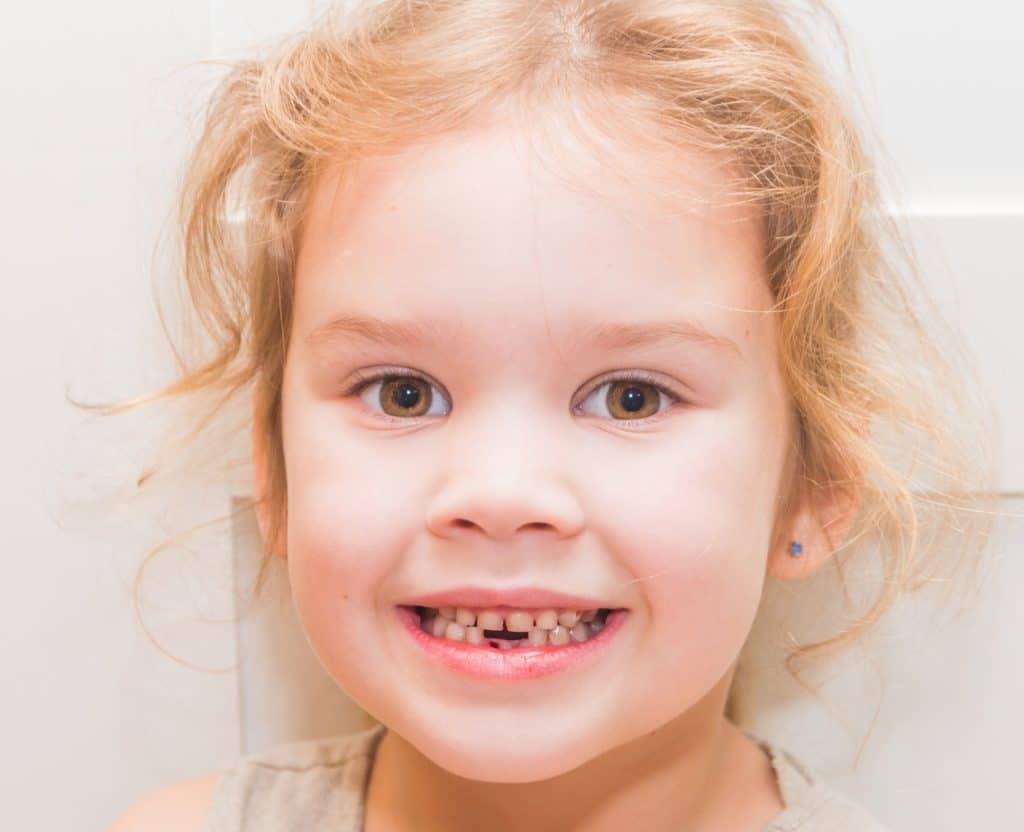
Milk teeth have many functions such as ensuring the place of the permanent teeth, the position of the tongue, swallowing but also to allow the child to eat well.
These temporary teeth usually start to fall out at the age of six. However, some children may lose their baby teeth early.
Let's find out the reasons and consequences of this early loss of baby teeth and what to do if it happens.
What is early baby tooth loss?
A loss of milk teeth is considered early when it occurs before the age of six.
Reasons for premature loss of baby teeth
The reasons for premature loss of baby teeth are :
- Un traumatisme, comme une chute de l’enfant, qui cause une cassure ou une expulsion des dents (généralement celles de devant),
- Cavities appearing especially on the temporary molars that are supposed to fall out naturally between the ages of 10 and 12. A tooth that is too decayed can break,
In very rare cases, early loss of baby teeth can also be due to hypophosphatasia, a genetic disease that originates from the malfunction of an enzyme (alkaline phosphatase).
This disease is manifested by a defect in bone and tooth mineralization which leads, among other symptoms, to premature tooth loss.
Consequences of early baby tooth loss
The timing of the exfoliation of the deciduous teeth and the eruption of the permanent teeth is very important.
Indeed, a baby tooth lost early leaves a gap and can no longer fulfill its role of maintaining space for the adult tooth.
The consequence is that the space eventually closes and may prevent the appearance of the permanent tooth. If the adult tooth still manages to grow in, the lack of space causes it to be poorly positioned in the mouth.
La pose d’un mainteneur d’espace après la perte précoce des dents de lait
Afin de prévenir tout problème sur les dents définitives suite à une perte précoce des dents de lait, le pédodontiste peut placer un mainteneur d’espace. Il s’agit d’un appareil en résine ou en métal fait sur mesure et qui peut être fixe ou amovible.
Role and operation
As its name indicates, its role is to maintain sufficient space in the dental arch. By preserving this space, the maintainer prevents another tooth from taking the place of the permanent tooth blocked under the gum. It also prevents adjacent teeth from tilting and taking the place of the permanent tooth.
The space maintainer is placed in the mouth around the tooth and is connected to a metal arm that protects the space.
In cases of agenesis, the placement of a space maintainer may be beneficial. This will depend on the case and only the pedodontist can evaluate the need for it.
How does a space maintainer fit in?
There are several steps to setting up a space maintainer.
The pedodontist begins by placing a pedodontic ring or cap on the tooth that borders the gap left by the prematurely fallen baby tooth.
He then makes an impression of the child's mouth with a paste called alginate. The operation is not painful but the taste of the paste can be unpleasant.
The resulting impression is sent to the laboratory responsible for manufacturing the space maintainer.
In a second session, the pedodontist has the child try on the space maintainer and then fixes it with a sealant (a type of glue).
Again, the operation is not painful and does not require putting the child to sleep.
What follow-up after the installation of a space maintainer?
After the space maintainer is placed, the pedodontist should be seen every six months to check the proper eruption of the permanent teeth with an x-ray.
The space maintainer remains in the mouth until the adult tooth erupts.
Si le mainteneur tombe, il est important de prendre rendez-vous en urgence pour le recoller. Il s ‘agit d’une opération rapide d’une quinzaine de minutes environ.
All maintenance procedures and precautions to be taken after placement are explained by the pedodontist before the space maintainer is placed.


