🏝 🐠    Bonnes vacances d’été!   🏝 🐠

The office is closed between July 26 and August 23 included. Until we see you again in the fall, we wish you a wonderful sunny vacation!

Le cabinet est fermé pour les vacances de fin d’année entre le 18 Décembre et le 6 Janvier inclus.

Best Practices For Your Child's Oral Health

Tous nos conseils pour prendre soin des dents de votre enfant et l’aider à garder un sourire sain toute sa vie
Key Points - Child Dentist

Key Points

Your child's oral hygiene should be made a priority from the earliest age possible.

Baby teeth need dental care even though they’re destined to fall out, and early attention to your child’s oral health with expose them to good dental practices at a young age and help keep their teeth healthy throughout their entire life.

          Dr. Adriana Agachi, Pediatric Oral Surgeon

dentist-dr-adriana-agachi

The Most Frequently Asked Questions Concerning Your Little One's Oral Health

When should I schedule my child's first dental visit?

Keep in mind that your child’s first visit to the dentist should be a pleasant experience, otherwise they might dread future dental appointments and even dental care. Therefore, it’s important to choose a dental practitioner that is well experienced with treating children. 

These professionals are called pediatric dentists, and are specially trained to treat children’s oral health. You should schedule la première visite à l’âge de deux-trois ans to:

Good oral hygiene, along with healthy dieting and habits are the keys to effective dental prevention.

How often should my little one visit the dentist and why?

You should schedule periodic checkups for your little one every 6 months or, at minimum, once every year, to monitor oral health and catch any cavities in early development. Baby teeth are actually more fragile because their enamel is less mineralized, making them more susceptible to attacks from acids and foods that then can cause rapid cavity development.

dr-agachi-adriana-dentists

How do I reassure my child at the dentist's office?

We know, children (and even adults sometimes!) can think going to the dentist is scary! That’s why can be useful to talk to your children before their dental visits. You can dedramatize the situation by explaining that the dentist is a doctor for children’s teeth, and that doctors are there to make sure everything is OK and that we’re all healthy. You can also give your child examples of people they know who also go to the dentist, and explain that you to go to the dentist so that they’ll take care of your teeth. 

In what order do my child's teeth make their appearances?

The appearances and disappearances of baby teeth

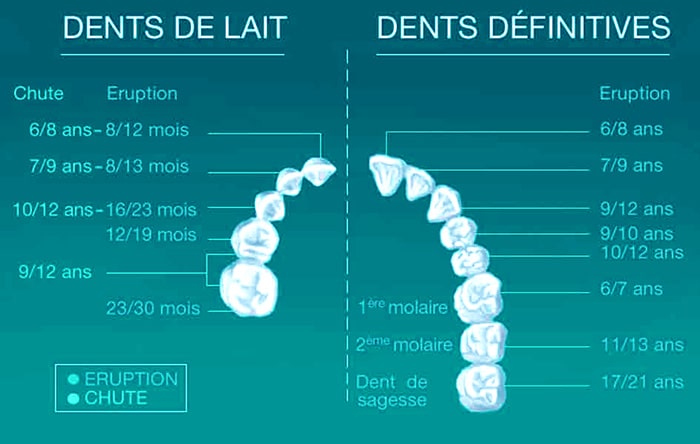
The first baby teeth generally appear around the age of 6 months. However, each child is unique and some children can wait a year before getting their first baby teeth.

The Appearance Of Baby Teeth

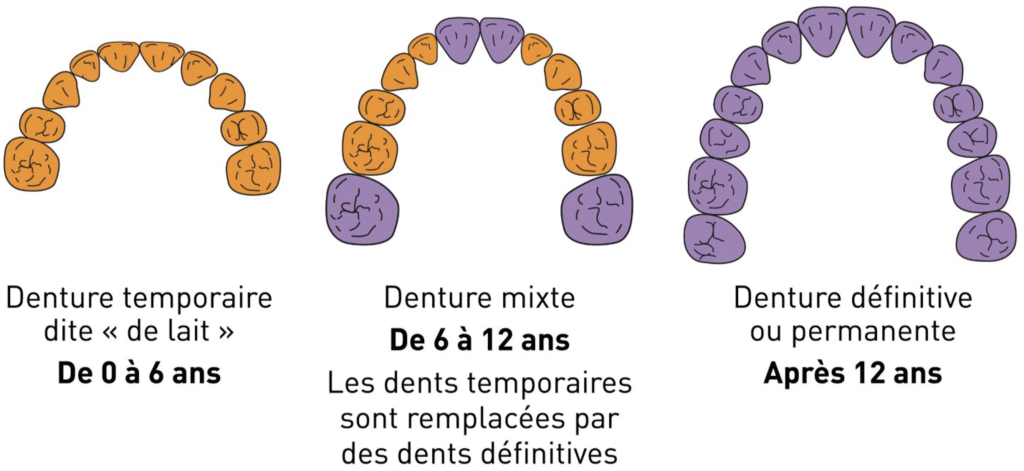
Permanent teeth generally start growing in around the age of 6, thus starting the process of replacing the child’s initial set of 20 baby teeth with 32 permanent ones. Permanent teeth start developing above baby teeth, wearing out their root until they fall out. This process is completely painless, contrary to the growth of baby teeth which is very painful.
Type of Teeth - Definitive Teeth Appearance - Child Dentist


The primary molars, or 6-year molars are the first permanent teeth to appear. These grow in the back of the mouth, behind the baby teeth. The following calendar shows the stages of permanent teeth development.

Type of teeth - Milk Teeth - Permanent Teeth - Child Dentistry

When should my child brush their teeth?

To ensure your child's good oral hygiene, you should assist and monitor your child's brushing until they are 8-10 years old

Your child should brush their teeth and gums for at least 2 minutes après tout repas ou grignotage (c’est pourquoi il faut éviter les boissons sucrées, lait et jus de fruits inclus, entre les repas!).

Your child should brush at minimum:

  • IN THE MORNING, after breakfast
  • IN THE EVENING, before bed with fluoride toothpaste made specifically for your child's age group.
 

Brushing is particularly indispensable at night when saliva secretions, which normally defend against attacks from acids and cariogenic bacteria, are reduced for sleep. Brushing before bed is therefore the primary means of reducing the number of bacteria present in the mouth while sleeping and consequently the risk of cavities.

Caution, after your child brushes their teeth in the evening, they shouldn’t have anything else to eat or drink- except water!

Your child should alsom when possible, brush their teeth in the AFTERNOON, following lunchBecause it's often difficult for your child to brush their teeth at school, they can alternatively rince their mouth and/or chew sugarless gum.
 

What toothbrush and toothpaste do you recommend for my child?

You should start brushing your child's teeth with fluoride toothpaste as soon as their first baby teeth appear! The toothbrush itself serves to clean plaque and bacteria, while the fluoride reinforces your child's tooth enamel and prevents cavities. 

Pick a toothpaste that has a fluoride concentration specific to your child's age group. Fluoride toothpaste can be found both in the pharmacy and over the counter, and they come in all sorts of flavors! Pick one that clearly indicates its fluoride concentration. 

Les autorités de santé recommend toothpaste with a maximum fluoride concentration of 500 ppm (parts per million) for children 2–6 years of age, and 1500 ppm for 7–12 years. But make surethat your child doesn't swallow the toothpaste

The fluoride present in the toothpaste is sufficient, and additional supplements in the form of drops or pills are not necessary (except when prescribed by a doctor).


6 months - 3 years: 

> Parents brush their children's teeth for them avec une brosse à dents souple adaptée à l’âge de l’enfant.

> Use a tooth paste with a fluoride concentration less than 500 ppm, en quantité égale à une graine de riz.ple manuelle adaptée à l’âge.


3-6 years: 

> Parents should brush their children's teeth for them using an electric toothbrush that performs both rotational and pulsating movements. 

> Your child's toothpaste should have a fluoride concentration of 500 ppm, and be applied in a quantity equal to the size of your child's pinky nail (or a pea!)

Prior to 6 years of age, it’s assumed that children are swallowing some of their toothpaste, and toothpastes for this age group are designed accordingly. Therefore, it’s necessary to be mindful of what toothpaste you’re giving your child and pay attention to fluoride concentrations in order to avoid an accidental overdose.


6 years and older:

Ideally, brushing should be done at least twice a day after meals. Le brossage du soir est particulièrement important puisque pendant la nuit la salivation diminue, il faut donc que les dents soient propres pour limiter le risque carieux. Il ne faut pas manger ou boire autre chose que de l’eau après s’être lavé les dents !

> Once children habitually spit out their toothpaste, the ideal fluoride concentration is between 1000-1500 ppm

You should start brushing your child's teeth with fluoride toothpaste as soon as their first baby teeth appear! The toothbrush itself serves to clean plaque and bacteria, while the fluoride reinforces your child's tooth enamel and prevents cavities. 

Pick a toothpaste that has a fluoride concentration specific to your child's age group. Fluoride toothpaste can be found both in the pharmacy and over the counter, and they come in all sorts of flavors! Pick one that clearly indicates its fluoride concentration. 

Les autorités de santé recommend toothpaste with a maximum fluoride concentration of 500 ppm (parts per million) for children 2–6 years of age, and 1500 ppm for 7–12 years. But make surethat your child doesn't swallow the toothpaste

The fluoride present in the toothpaste is sufficient, and additional supplements in the form of drops or pills are not necessary (except when prescribed by a doctor).


6 months - 3 years: 


> Parents brush their children's teeth for them avec une brosse à dents souple adaptée à l’âge de l’enfant.

> Use a tooth paste with a fluoride concentration less than 500 ppm, en quantité égale à une graine de riz.ple manuelle adaptée à l’âge.


3-6 years: 

> Parents should brush their children's teeth for them using an electric toothbrush that performs both rotational and pulsating movements. 

> Your child's toothpaste should have a fluoride concentration of 500 ppm, and be applied in a quantity equal to the size of your child's pinky nail (or a pea!)

Prior to 6 years of age, it’s assumed that children are swallowing some of their toothpaste, and toothpastes for this age group are designed accordingly. Therefore, it’s necessary to be mindful of what toothpaste you’re giving your child and pay attention to fluoride concentrations in order to avoid an accidental overdose.


6 years and older:

Ideally, brushing should be done at least twice a day after meals. Le brossage du soir est particulièrement important puisque pendant la nuit la salivation diminue, il faut donc que les dents soient propres pour limiter le risque carieux. Il ne faut pas manger ou boire autre chose que de l’eau après s’être lavé les dents !

> Once children habitually spit out their toothpaste, the ideal fluoride concentration is between 1000-1500 ppm

What do you think about flouride supplements for children?

First and foremost, fluoride is and remains a principal tool in the fight for cavity prevention. However, its administration can be nuanced. For example, the latest studies show that fluoride effects are more pronounced when applied locally. This is why we recommend direct fluoride treatments, such as children’s fluoride toothpaste as well as topical fluoride treatments every six months at checkups. 

Similarly, there are also fluoride trays and pastes that are useful in cases where tooth enamel is particularly fragile.

The recommended fluoride intake is 0.05 mg/kg per day, which can be naturally met with fluoridated foods such as table salt, bottled water (and certain carbonated waters in particular), as well as children’s toothpaste. 

Oral fluoride supplements (lozenges) are now prohibited. Moreover, according to the latest AFSSAPS recommendations (2008), fluoride supplements should not be given before the age of 6 months.

Why is it necessary to brush baby teeth?

As soon as your child's first baby tooth makes its appearance, you should start taking care of their teeth and prevent cavity development

It's easy to get confused and think that cavities on baby teeth aren't serious because baby teeth will eventually fall out. However, cavities are contagious and can affect permanent teeth as well as other teeth in the mouth.

It's also important to ensure that your child receives regular dental cleanings and to teach them good oral hygiene to avoid complications with their permanent teeth.

How should I brush my child's teeth?

Use the BCDF method:

> Brush the top and bottom teeth separately
> Circular motions for the teeth and massaging the gums
> Declination of 45° for the gums (to avoid damaging them)
> Follow a specific route so that you remember to get all the teeth.


Some tips and tricks for holding the toothbrush correctly:


1. Hold the toothbrush at a 45° angle with respect to the gum line. Brush 2 or 3 teeth at a time using circular motions, brushing from the gums to the tips of the teeth.


2. Hold the toothbrush vertically to clean behind and in front of the upper and lower teeth, gently moving the toothbrush up and down.


3. Hold the toothbrush facing the chewing surface of the teeth and gently clean using back and forward motions.

Use the BCDF method:

> Brush the top and bottom teeth separately
> Circular motions for the teeth and massaging the gums
> Declination of 45° for the gums (to avoid damaging them)
> Follow a specific route so that you remember to get all the teeth.

Some tips and tricks for holding the toothbrush correctly:

1. Hold the toothbrush at a 45° angle with respect to the gum line. Brush 2 or 3 teeth at a time using circular motions, brushing from the gums to the tips of the teeth.

2. Hold the toothbrush vertically to clean behind and in front of the upper and lower teeth, gently moving the toothbrush up and down.

3. Hold the toothbrush facing the chewing surface of the teeth and gently clean using back and forward motions.

How do I motivate my child to brush their teeth?

Ce n’est pas toujours facile de motiver son enfant à se brosser les dents. Vous pouvez alors lui parler des microbes qui font la fête dans sa bouche la nuit et rendre le brossage ludique avec des comptines, une application sur téléphone, ou un tableau sur lequel il/elle colle un sticker après chaque brossage. 


Your child will also enjoy choosing their own toothbrush and toothpaste! Children have a lot to choose from, toothbrushes and toothpastes in all sorts of colors and flavors, some with their favorite cartoon characters!

N’oubliez pas de vérifier son brossage tous les soirs et de le compléter si besoin!


What type of toothbrush should my child use?

There are many kinds of children’s toothbrushes available, and these can offer features to accommodate children’s tiny hands and mouths.

For example, larger handles can help children control the toothbrush better.

Soft, rounded bristles ensure a gentle cleaning of the teeth and gums.

Finally, bright colors and fun shapes encourage brushing by leaving a bit of room for fun!

Should my child floss?

L’utilisation quotidienne après le brossage du soir d’un fil dentaire pour enfants élimine la plaque le long de la ligne gingivale et entre les dents.

* Your child’s gums should appear firm and pink. If they are red, swollen, or bleeding- then it’s time for a dental visit!
* Don’t discontinue flossing altogether if your child’s gums bleed. Flossing can improve gum health and help prevent gums from bleeding.

What do you think of chewing gum for kids?

After meals, if it's not possible to brush, chewing sugarless gum can offer several benefits:

– cleaning teeth by the mechanical effect

– salivation qui aide à la remontée du pH en bouche (on rappelle qu’un pH>5,5 est normal et que des sodas comme le Coca-Cola peuvent le faire baisser à 2,3)

We particularly recommend chewing gum that contains xylitol (a sweetener that stops bacteria proliferation). Chewing gum can also benefit children who suffer from dry mouth or a mouth that is too acidic.

Chewing gum is not a replacement for brushing. However, after a snack or meal out, it's better than doing nothing! Rinsing the mouth with water is equally recommended.

What causes children's cavities?

Cavities are the result of one or more of the following factors:

- Cavity causing bacterias : Mutans Streptococci and Lactobacillus Acidophile, which form plaque

- Sugar (noting that even foods like bread and milk contain sugar)

- Acid (pH <5,5, for example, Coca Cola has a pH of 2.3) 

- Poor or irregular brushing habits 

Une mauvaise qualité de l’émail (linked to genetic and environmental factors) 

Ineffective saliva 

- Gastointenstinal issues (gastroesophageal/acid reflux) 

- A tongue frenulum that's too short, qui empêche la langue d’atteindre toutes les dents et d’accomplir son rôle nettoyant

Tutorial - How to Protect Teeth from Decay - Child Dentist

How can I protect my child's teeth against cavities?

Des solutions existent! En plus d’une hygiène bucco-dentaire exemplaire et des visites régulières chez le dentiste, nous pouvons vous proposer des traitements adaptés:

Are cavities on baby teeth serious?

Yes, they're serious! Cavities are both INFECTIOUS and TRANSMISSIBLE.

Avoir des caries sur les dents de lait montre que l’enfant est porteur de bactéries cariogènes (Streptocoques Mutans et Lactobacille Acidophile), que toutes les conditions pour que des caries se forment sont réunies, et il y a donc de très fortes chances pour que l’enfant développe des caries sur les dents définitives.

5 billion people in the world suffer from cavities (in certain countries 60–90% of the population). In France, 50% of children have had at least one cavity by the age of 12.

Cavities on baby teeth can also be part of a more serious condition known as baby bottle tooth decay which can result in the loss of all the child’s baby teeth and cause severe secondary complications involving pronunciation, learning language, nutrition, etc.

Is it necessary to treat baby teeth even though they'll eventually fall out?

It's a common misconception that baby teeth don't need to be treated because they'll eventually be replaced by permanent teeth!

Baby teeth serve many indispensable purposes, from the functional (chewing, pronunciation, etc.) to the aesthetic.

Damage to a baby tooth can also cause significant damage to permanent teeth.

Baby teeth help ensure the proper growth and alignment of permanent teeth.

It's therefore imperative to treat affected baby teeth.