
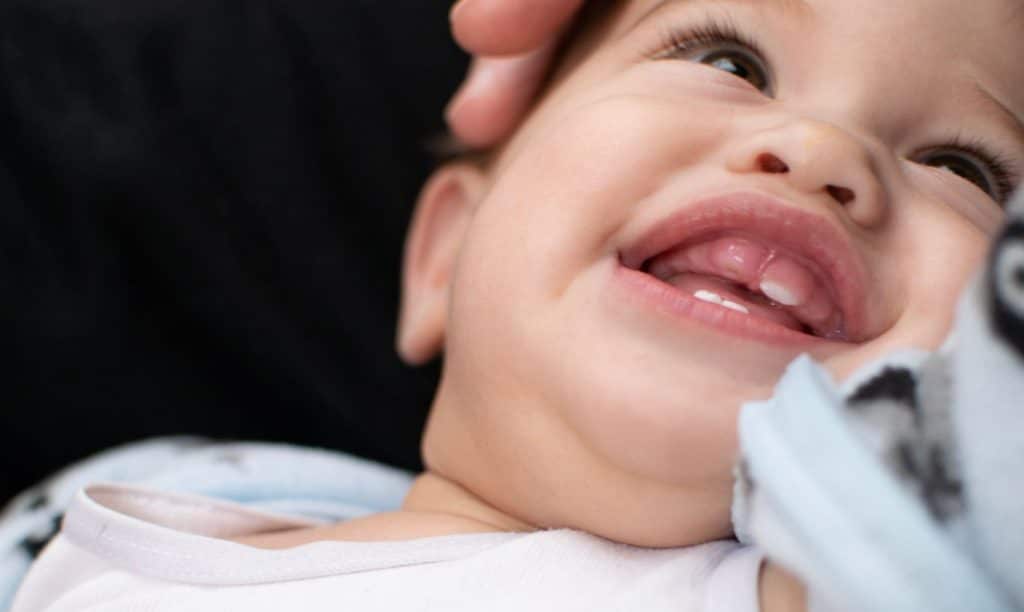
Les dents d’un enfant se forment in utero dès la 6ème semaine de grossesse. Mais les dents ne finissent par sortir que plusieurs mois après la naissance, lorsque baby is teething. During this period, the teeth pass through the jawbone and the gum.
Learn about the order of baby's teething in this article.
The order of teething in babies
Baby's teeth come out in the following order:
- The two lower incisors,
- The two upper incisors,
- The lateral incisors,
- The first molars,
- Canines,
- The second molars.
Sometimes a baby's first tooth may appear on top first. The order of appearance of the teeth may vary from child to child. The symmetry of the growth is more important than the order of appearance. When a tooth grows on one side of the jaw, it is important that the opposite tooth comes out within 6 months.
Thus, by the age of 3, a child has 20 baby teeth. During childhood, the 32 permanent teeth develop in the jaw and begin to replace the milk teeth at age 6.
Dents de lait : quel est l’ordre d’apparition ?
Typically, teething begins around 6 months of age with the appearance of the lower incisors. Between 6 and 12 months, the lower and upper incisors appear.
Then between 9 and 13 months, the lateral incisors grow. Between 13 and 19 months, the first molars appear. The canines grow between 16 and 22 months. Finally, between 25 and 33 months, the second molars start to come out.
The timing of the appearance of baby teeth is not fixed. Some babies may get their baby teeth earlier than others. Some children are even born with a tooth.
Many parents use necklaces to soothe teething problems. Discover our dedicated article to know if these necklaces are really effective to make the exit of baby's teeth less painful.
No baby teeth: should you be concerned?
While teething usually starts around 6 months of age, some children still have no teeth at 12 months. However, there is no reason to worry. In fact, each child has his own development and evolves at his own pace.
A visit to the dentist is generally recommended around the age of one. During this consultation, the pedodontist checks the future appearance of baby teeth and the good oral health of the baby.
Notez également que cette visite chez le pédodontiste permet éventuellement d’identifier ou résoudre certaines anomalies telles que :
- A permanent tooth growing behind a baby tooth,
- A baby's first tooth growing out of place,
- A tooth that grows in the palate.
Babies' baby teeth appear between 6 months and 3 years. During this period, baby goes through dental flare-ups that can be identified by several symptoms. There are many tips to relieve baby's teething problems.


